
Community Service (Abdimas) UBM Serpong Campus at SMP Santo Paulus 3 “Y(ou)ng Young Y(ou)ng Entrepreneur”
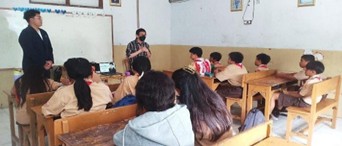
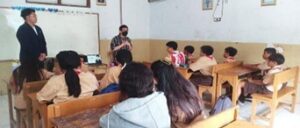
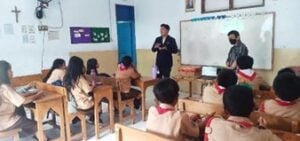
The Management Study Program of Bunda Mulia University, Serpong Campus, held an incidental Community Service (Abdimas) activity with the theme ” Young Entrepreneurs “. The Abdimas activity was held on Wednesday, November 26, 2025 with a total of 14 participants who were students of Santo Paulus 3 Middle School in grades VII, VIII, and IX. In its implementation, it was assisted by an active student of Bunda Mulia University, Serpong Campus, named Marcello Vially Alessandro. The speaker in the first Abdimas activity was Mr. Hary S. Sundoro, SE., ME as a lecturer in the Management Study Program. He presented material on “Introduction to Entrepreneurship”. In the material presented, it explained that current global challenges are urging the entire world of education to prepare students for the future to become a talented generation. Talented here means that students are equipped with various skills or abilities from an early age. Soft skills include communication, teamwork, problem solving, leadership, and adaptation. Meanwhile, examples of hard skills include foreign language skills, programming, data analysis, software use, and machine operation. Furthermore, students acquire skills intended for life, therefore students are expected to develop an entrepreneurial spirit from an early age.
Entrepreneurship is an independent business activity carried out by an individual (entrepreneur) by managing resources and taking risks to create products or services, with the goal of gaining profit and contributing to the economy through job creation and increasing gross domestic product (GDP). Entrepreneurship education is primarily aimed at equipping students with life skills, namely being independent and able to face frequent changes. Being independent means that later in work there is no need to depend on others, for example: permanent workers with a monthly salary are afraid of being fired. Because being an entrepreneur actually creates jobs for others. Being able to face frequent changes is intended so that later when there are unexpected conditions, such as the COVID-19 pandemic which caused economic turmoil – many people were laid off, entrepreneurs need not worry because they created their own jobs. Some characteristics of entrepreneurs include: independence, creativity, innovation, responsibility, discipline, and perseverance.
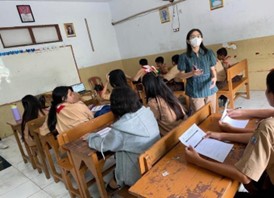
After the first session was over, the speaker for the second Abdimas activity, Ms. Grace Putlia, SE., MM, a lecturer in the Management Study Program, began her presentation. She presented the material on “Core Things You Need to Prepare When Starting an Entrepreneurship.” She explained that there are three core things that can be prioritized to start an entrepreneur: 1) Mentality. Strong Confidence – start by thinking, ” Do What You Want ” and ” Do What You Love .” Do activities according to your wishes and do activities that you like/love (hobbies). Here, it does not mean being arbitrary so that you think carelessly, but this is a great opportunity that entrepreneurs have and cannot be owned by permanent workers. Never Give Up – consider that every entrepreneur starts their business from the bottom, there will definitely be many problems facing them. Entrepreneurs must never give up. So, if you start from something you want/like, you will be able to overcome all problems steadfastly. 2) Capital . Consider that every entrepreneur starts their business from the bottom, the main thought that arises and often becomes a fear is: “Where will the capital come from?” If the mentality is determined, then point 2 for this capital can be found a solution: personal savings (avoid interest), loans from parents (avoid interest), loans from relatives (avoid interest), loans from friends/companions (avoid interest), joint/joint method, loans to banks (choose the lowest interest; KUR) **start from small capital first, with precise calculations . 3) 4P. At this point regarding the 4Ps, further details will be directly presented in the sharing session by students. Therefore, this second session was followed up with a quiz game in the form of questions to ensure the focus of the participants. The participants enthusiastically answered the questions given. The Abdimas activity continued with a sharing session by students, who participated in order to be able to practice directly in the community where this session was also the last session. An active student of UBM Serpong Campus named Marcello Vially Alessandro shared his experience in managing a business.
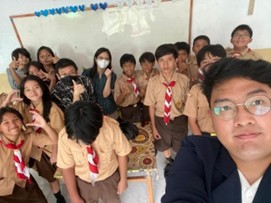
The experience of entrepreneurship in the F&B sector that has been established for 11 years is certainly not a trivial business. Marcello Vially Alessandro is not the founder of Uncle Jow Bakery, but continuing his parents’ business with development and innovation is not a trivial matter. Marcello explained that when starting a business, the 4Ps must be carefully considered to avoid making mistakes. What product to sell must keep up with current trends; Price ; market research is needed to determine the appropriate price range; Place ; use whatever space you have available for the start-up and utilize the internet for sales; Promotion ; inform about the product and selling price to attract potential buyers by utilizing free promotional media such as social media. One thing that is quite difficult to do is laziness that often arises. Entrepreneurs must be good at managing time and managing themselves. Marcello also did not forget to provide tips for overcoming laziness that have been implemented so far. After all the speakers finished presenting their materials, even though there was only a short time left, a question and answer session was still held. In this session, only a few participants asked questions, because in each of the previous speaker sessions there were already quite a lot of questions that were immediately answered. The Community Service activity was then closed with a group photo. The community service activities at SMP Santo Paulus 3 demonstrated that knowledge and concepts remain essential for practical application. Participants were asked to provide feedback, with the majority expressing their hope that the community service activities could be repeated in the future, if possible, with topics relevant to current conditions.