



The UBM Studium Generale Series 025: UBM Discusses the Role of AI in Visual Communication and the Challenges of Automation of Deception
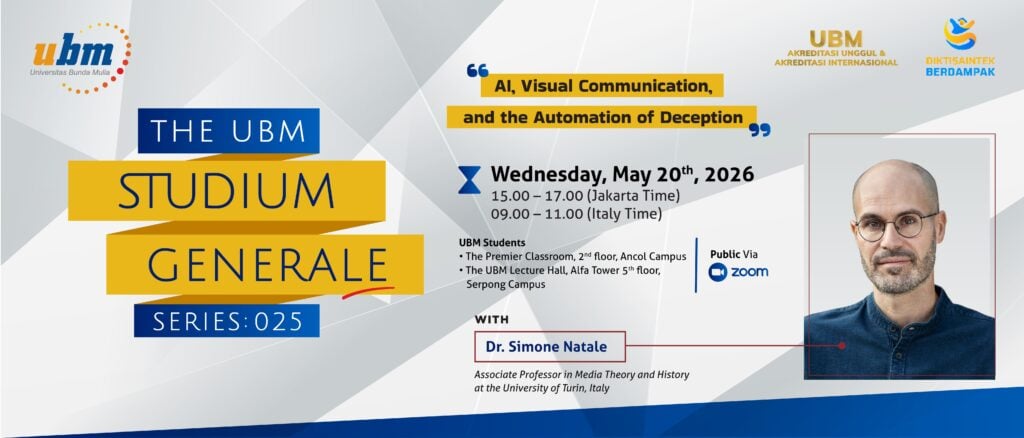
Tangerang, May 20, 2026 — The development of artificial intelligence, particularly generative AI, has brought about major changes in the world of visual communication. Technology previously understood as a tool for design production has now evolved into a system capable of shaping meaning, mediating reality, and influencing how audiences perceive information. This phenomenon is becoming increasingly important to study, especially as the line between authentic and technologically manipulated visuals becomes increasingly difficult to distinguish.
Responding to this issue, Bunda Mulia University held The UBM Studium Generale Series 025 with the theme “AI, Visual Communication, and the Automation of Deception” on Wednesday, May 20, 2026 , at 3:00 PM – 5:00 PM WIB . This activity was held in a hybrid manner at the Ancol Campus and Serpong Campus of Bunda Mulia University, presenting Dr. Simone Natale from the University of Turin, Italy , as an international resource person, and Dr. Adhiguna Mahendra as moderator.
In this activity, participants were encouraged to view AI not only as a technological advancement, but also as a social and visual cultural phenomenon with far-reaching consequences. Generative AI is now capable of producing highly convincing images, narratives, and digital content. On the one hand, this technology opens up enormous opportunities for the design and creative industries. However, on the other hand, this capability also presents ethical challenges, particularly regarding information manipulation, the production of misleading visuals, and the increasing potential for deception in the digital media ecosystem.
The discussion on the automation of deception is relevant for students, academics, and practitioners of visual communication design, as the development of AI demands new capabilities in reading, evaluating, and accounting for visual messages. Through this forum, students are encouraged to not only master the technology but also understand the ethical context, creative responsibility, and the shift in roles from human agency to algorithmic agency in contemporary visual communication production.
This activity also has a strong connection with the learning process in the Visual Communication Design Study Program, particularly in courses such as Introduction to Artificial Intelligence, Design Ethics, Design Thinking & Research, UI/UX Design, Transmedia Storytelling , and Conceptual Art . Thus, this studium generale is not only a space for inspiration, but also part of strengthening students’ academic literacy on cutting-edge issues at the intersection of technology, communication, and global visual culture.
Participants’ responses to this activity were positive. Based on the feedback collected, the majority of participants gave “Good” and “Very Good” ratings for the usefulness of the material, the relevance of the topic, the implementation of the activity, and the presentation of the speakers. This indicates that the activity was deemed capable of providing new insights, broadening participants’ understanding, and presenting discussions relevant to academic needs and current developments in the creative industry.
Through the UBM Studium Generale Series 025 , Bunda Mulia University affirms its commitment to presenting academic activities that are up-to-date, critical, and globally oriented. The presence of international speakers is part of UBM’s efforts to broaden students’ exposure to global scientific developments, while simultaneously strengthening the university’s position as a higher education institution that is adaptive to changes in technology, communications, and the global creative industry.