



General Lecture of the Distance Learning Management Program, Universitas Bunda Mulia “Systemic Stability: Protecting the Future of Banking and Financial Institutions”
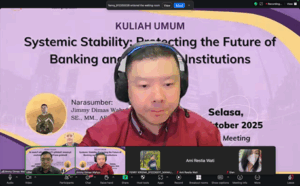
Jakarta, October 14, 2025 — The Distance Learning (PJJ) Management Program of Universitas Bunda Mulia (UBM) successfully held a public lecture with the theme “Systemic Stability: Protecting the Future of Banking and Financial Institutions.”
The event took place on Tuesday, October 14, 2025, from 6:30 p.m. to 8:00 p.m. and was attended by active students of the PJJ Management Program. The lecture featured Mr. Jimmy Dimas Wahyu Indraseno, SE., MM., AEPP., CFP., CMW, Instructor at the Certified Wealth Managers Association (CWMA), as the keynote speaker, and was moderated by Mr. Very Budiyanto, S.M., M.SE, lecturer of the Management Study Program.
The topic of this lecture aligns closely with the course “Banking and Other Financial Institutions,” which discusses the roles, functions, and stability of financial institutions in maintaining economic balance. Through this session, students gained a comprehensive understanding of systemic stability, risk management, and the role of monetary policies and regulations in ensuring the sustainability of the banking and financial sectors in the future.
In his presentation, Mr. Jimmy Dimas Wahyu Indraseno emphasized that financial system stability is the cornerstone of a healthy and sustainable economy. Without a stable financial system, the risk of crisis can easily spread and affect the real sector, ultimately impacting societal welfare. He explained that systemic stability depends not only on the strength of the banking system but also on the synergy among financial institutions, regulatory effectiveness, and the active role of supervisory authorities such as the Financial Services Authority (OJK) and Bank Indonesia (BI) in maintaining public confidence.
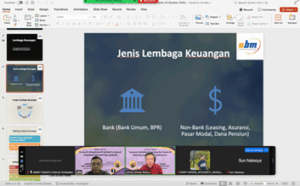
Furthermore, Mr. Jimmy highlighted the emerging challenges of digital financial transformation, where innovations such as fintech, digital banking, and crypto assets present significant opportunities while also introducing new risks to national financial systems. He stressed the need for strong governance frameworks and enhanced human capital capacity to manage increasingly complex risks, alongside promoting transparency, consumer protection, and financial literacy to ensure that digital innovation supports rather than disrupts financial stability.
Students actively participated in the discussion and Q&A session, demonstrating great enthusiasm and curiosity. The session enriched their understanding of theoretical concepts learned in class and how they apply in real-world financial contexts.
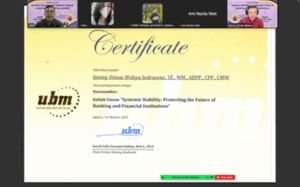
Through this event, the Distance Learning Management Program of Universitas Bunda Mulia reaffirms its commitment to providing relevant and applicable learning experiences that bridge academic theory and industry practice, preparing graduates to be competent, adaptive, and ready to contribute to the sustainable development of Indonesia’s financial sector.