


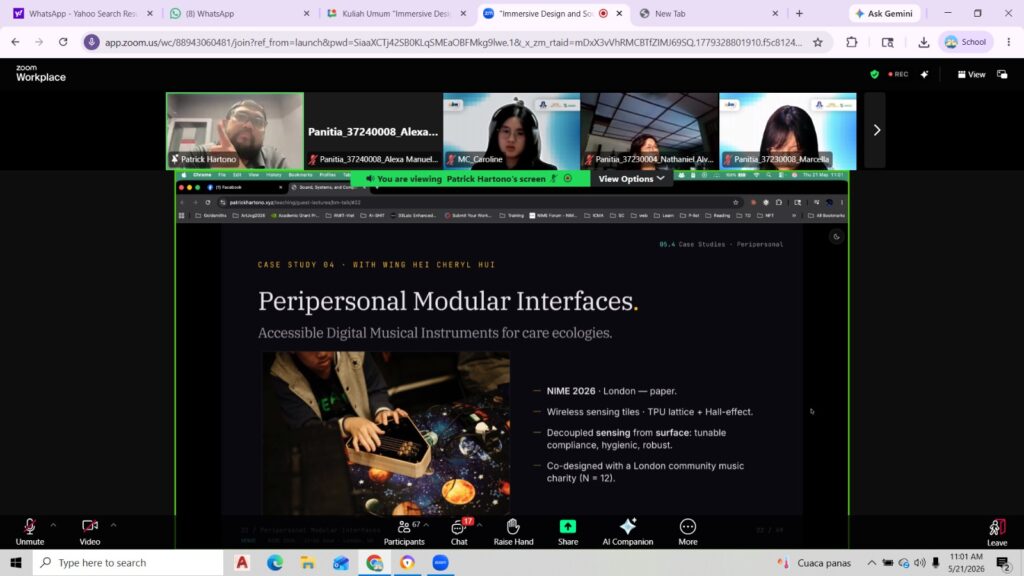
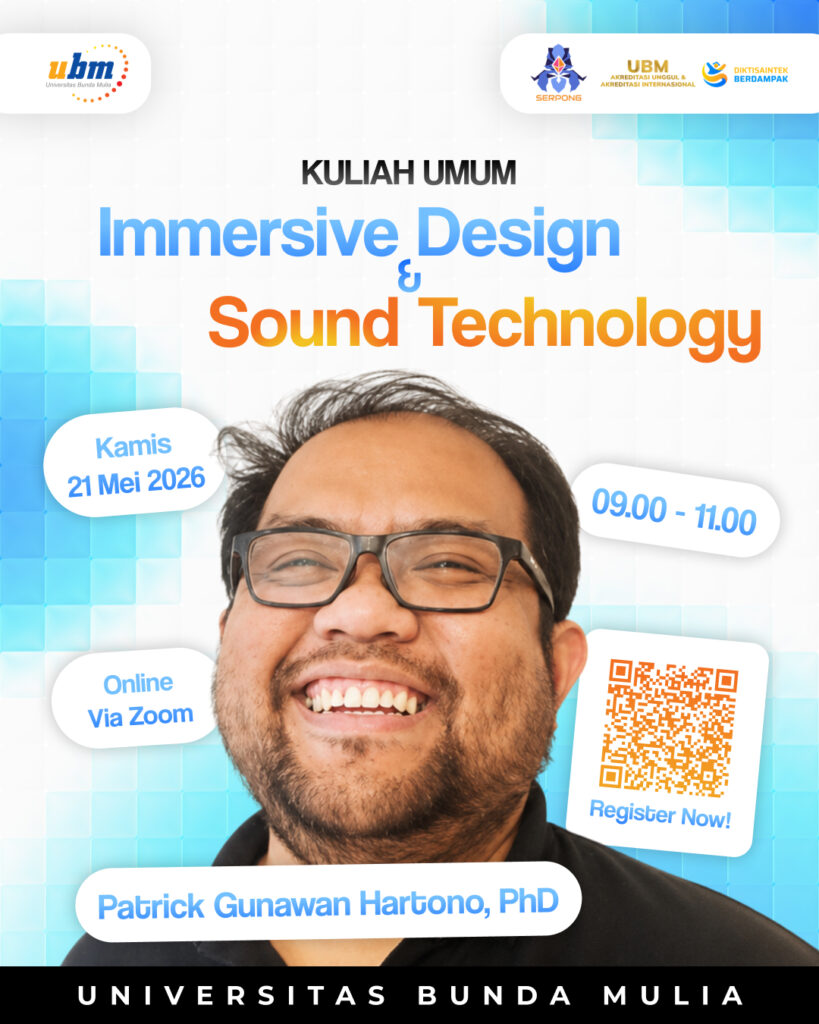
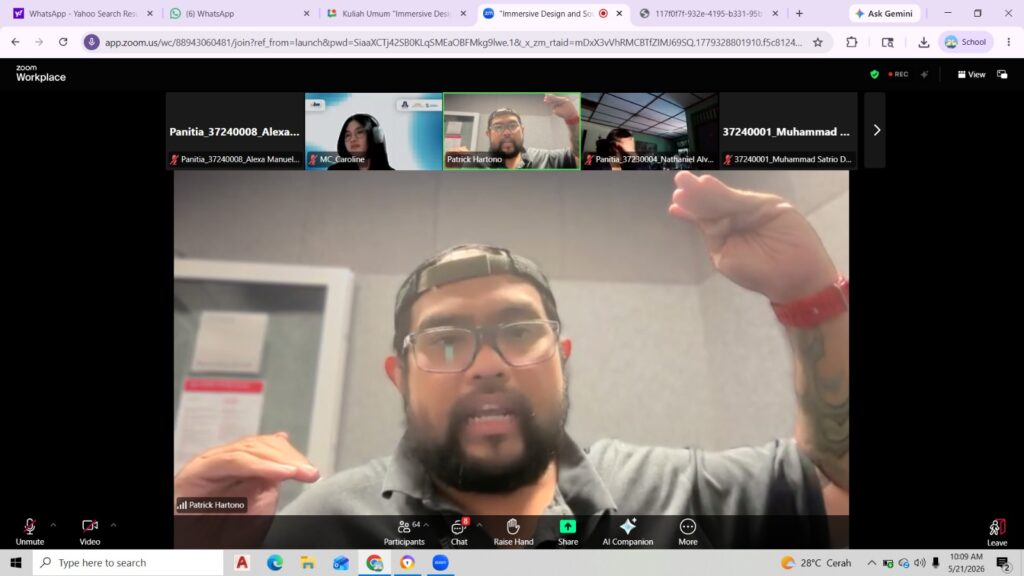
On Thursday, May 21, 2026, the Interactive Design Study Program of Bunda Mulia University once again organized a public lecture as part of its commitment to broadening students’ perspectives on technological advancements and professional practices in the global creative industry. Conducted online via Zoom from 10:00 AM to 12:00 PM (WIB), the event carried the theme **“Immersive Design and Sound Technology”** and featured **Patrick G. Hartono, Ph.D.** as the keynote speaker.
The event proceeded smoothly and received enthusiastic participation from attendees. During his presentation, Patrick G. Hartono, Ph.D. discussed the evolution of immersive design as a design approach that enables deeper interactive experiences through the integration of visual, audio, and digital interaction technologies. He explained that contemporary interactive design no longer focuses solely on visual aesthetics, but also on how users can experience more responsive, intuitive, and emotionally engaging interactions through the use of multimedia and sensory technologies.
As a researcher and artist whose practice integrates technology and computational methodologies, Patrick G. Hartono, Ph.D. also shared his creative explorations and professional experiences in electroacoustic music, generative visuals, embodied interaction, and creative collaboration between humans and artificial intelligence. He currently serves as a Lecturer in Digital Media (Interaction) at RMIT Vietnam and previously taught Computational Arts at Goldsmiths, University of London. Through various case studies and project presentations, students gained insights into how sound technologies and interactive media can be developed into innovative and practical immersive experiences within the contemporary creative landscape.
In addition, the speaker highlighted the important role of sound technology in creating more engaging and communicative user experiences. Participants were introduced to a range of approaches in interactive audio exploration, spatial sound, and the application of artificial intelligence in digital media-based creative processes. The session provided valuable insights into the relationship between art, technology, and user experience in the development of interactive works that align with the current evolution of the global creative industry.
The discussion and Q&A session were highly active and interactive. Students raised various questions regarding the implementation of immersive design in the creative industry, the development process of sound-based interactive media, and future opportunities for collaboration between art and technology. These discussions helped students understand how interactive design theories can be applied in professional practice while offering new perspectives on the rapidly evolving landscape of creative technologies.
Overall, the public lecture entitled **“Immersive Design and Sound Technology”** was successfully conducted and made a positive contribution to students’ understanding of immersive media, sound technology, and contemporary interactive design. The event not only broadened students’ academic knowledge but also encouraged the development of creativity, technological exploration skills, and preparedness to face the challenges of the ever-evolving digital creative industry.
======================================================================================
Kuliah Umum “Immersive Design and Sound Technology”
Pada hari Kamis, 21 Mei 2026, Program Studi Desain Interaktif Universitas Bunda Mulia kembali menyelenggarakan kuliah umum sebagai bagian dari upaya memperluas wawasan mahasiswa terhadap perkembangan teknologi dan praktik profesional di industri kreatif global. Kegiatan yang dilaksanakan secara online melalui Zoom pada pukul 10.00–12.00 WIB ini mengangkat tema “Immersive Design and Sound Technology” dengan menghadirkan Patrick G. Hartono, Ph.D. sebagai pembicara utama.
Acara berlangsung dengan lancar dan mendapatkan antusiasme tinggi dari para peserta. Dalam sesi pemaparan materi, Patrick G. Hartono, Ph.D. membahas perkembangan immersive design sebagai pendekatan desain yang mampu menghadirkan pengalaman interaktif secara lebih mendalam melalui integrasi teknologi visual, audio, dan interaksi digital. Narasumber menjelaskan bahwa desain interaktif saat ini tidak lagi hanya berfokus pada tampilan visual, tetapi juga pada bagaimana pengguna dapat merasakan pengalaman yang lebih responsif, intuitif, dan emosional melalui pemanfaatan teknologi multimedia dan sensorik.
Sebagai seorang peneliti dan seniman yang praktiknya mengintegrasikan teknologi serta metodologi komputasional, Patrick G. Hartono, Ph.D. juga membagikan berbagai pengalaman dan eksplorasi kreatifnya dalam bidang musik elektroakustik, visual generatif, embodied interaction, serta kolaborasi kreatif antara manusia dan kecerdasan buatan. Saat ini beliau menjabat sebagai Lecturer in Digital Media (Interaction) di RMIT Vietnam dan sebelumnya mengajar Computational Arts di Goldsmiths, University of London. Melalui berbagai studi kasus dan proyek yang dipresentasikan, mahasiswa diajak memahami bagaimana teknologi suara dan media interaktif dapat dikembangkan menjadi pengalaman immersive yang inovatif dan aplikatif dalam dunia kreatif kontemporer.
Selain itu, narasumber juga menjelaskan bagaimana sound technology memiliki peran penting dalam membangun pengalaman pengguna yang lebih hidup dan komunikatif. Peserta diperkenalkan pada berbagai pendekatan eksplorasi audio interaktif, spatial sound, hingga penggunaan kecerdasan buatan dalam proses kreatif berbasis media digital. Materi yang disampaikan memberikan wawasan baru mengenai keterkaitan antara seni, teknologi, dan pengalaman pengguna dalam menciptakan karya interaktif yang relevan dengan perkembangan industri kreatif global saat ini.
Sesi diskusi dan tanya jawab berlangsung secara aktif dan interaktif. Mahasiswa mengajukan berbagai pertanyaan terkait penerapan immersive design dalam industri kreatif, proses pengembangan media interaktif berbasis suara, hingga peluang kolaborasi antara seni dan teknologi di masa depan. Diskusi ini membantu mahasiswa memahami bagaimana teori desain interaktif dapat diterapkan secara nyata dalam praktik profesional, sekaligus membuka perspektif baru mengenai perkembangan teknologi kreatif yang semakin dinamis.
Secara keseluruhan, kuliah umum “Immersive Design and Sound Technology” berjalan dengan baik dan memberikan dampak positif terhadap pemahaman mahasiswa mengenai perkembangan immersive media, sound technology, dan desain interaktif kontemporer. Kegiatan ini tidak hanya memperluas wawasan akademik mahasiswa, tetapi juga mendorong pengembangan kreativitas, kemampuan eksplorasi teknologi, serta kesiapan mahasiswa dalam menghadapi tantangan industri kreatif digital yang terus berkembang.